
Is Your Child Ready for NEET or JEE?
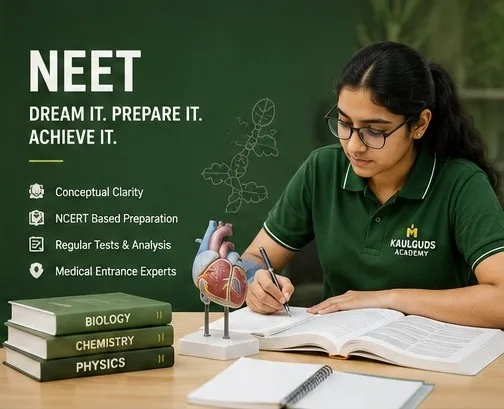
Preparing for NEET Medical Preparation?
Discover Kaulguds Academy’s proven curriculum, Mudra faculty mentoring, and small batch methodology in Aundh.
When a child completes Class 10 with strong marks in science and mathematics, the automatic assumption in many households is that they must enroll in two-year coaching for IIT-JEE or NEET. In urban educational hubs like Pune, peer momentum is powerful: when classmates and neighbors sign up for competitive coaching batches, parents fear that delaying or exploring other options will leave their child at an irreversible disadvantage.
Yet, teaching and mentoring students at Kaulguds Academy in Aundh since 1983, we have witnessed both extraordinary success stories and heartbreaking instances of burnout. Preparing for national-level entrance exams is not simply a continuation of school; it is an intensive marathon requiring distinct cognitive traits and emotional resilience. For medical aspirants, joining our dedicated NEET entrance coaching program provides the diagnostic mentorship and paced doubt-solving needed to build stamina without burnout.
Before committing two years of time, financial resources, and emotional energy, parents should evaluate four objective indicators of readiness.
1. Cognitive Aptitude: Passion for Concepts vs. Memorization Comfort
Liking "Science" in school often means enjoying colorful textbook illustrations or memorizing facts about space and human biology. Competitive entrance preparation, however, demands something much narrower: comfort with abstract problem-solving and mathematical reasoning.
Consider how a student responds when faced with an unfamiliar scenario: - When a mathematics or physics question cannot be solved on the first attempt, does the student show curiosity, or do they immediately experience anxiety and frustration? - Can they sit with a single difficult numerical problem for 20 minutes without reaching for the answer key? - In Chemistry, do they understand the logic behind atomic structures and periodic trends, or do they rely purely on rote recall?
For JEE, strong mathematical intuition and spatial reasoning are non-negotiable. For NEET, while exhaustive NCERT Biology memorization is essential, students must also solve complex numerical physics problems under extreme speed constraints (nearly 45 physics numericals in 50 minutes). A student who dislikes calculations will find both paths agonizing.
2. Emotional Stamina and Resilience to Low Test Scores
In school, hardworking students are accustomed to scoring 85% to 95%. When they enter competitive coaching, early test scores routinely drop into the 40% to 55% range.
How a student processes this drop determines their survival in the course: - Fragile Performers: Treat a low score as an indictment of their self-worth. They spiral into panic, lose motivation, and begin avoiding classes or homework. - Resilient Performers: View a 45% score as a diagnostic blueprint. They calmly examine the question paper, identify that 15 marks were lost due to careless arithmetic and 10 marks due to unrevised formulas, and set to work rectifying those specific deficits.
If your child is hyper-sensitive to academic setbacks, plunging them into a cutthroat 100-student coaching hall will likely destroy their confidence. They need a supportive, small-classroom setting with active mentoring, or perhaps an alternative pathway such as MHT-CET or pure sciences.
3. Independent Self-Study Discipline
Enrolling in the best coaching institute in the country achieves nothing if the student does not back it up with four to five hours of daily, solitary self-study.
Ask yourself these practical questions about your child's current study habits: - Does the student initiate study sessions independently, or do parents have to repeatedly nag them to sit at their desk? - Can they study for two hours with their smartphone turned off or placed in another room? - Do they manage their time effectively during vacations, or does routine collapse entirely without external supervision?
Competitive preparation requires self-directed execution. Faculty can explain complex concepts and assign curated problem sets, but the cognitive heavy-lifting must happen alone at the study desk.
4. The Home Environment: Pressure Cooker vs. Safe Harbor
Finally, parents must look inward at their own expectations. The most successful entrance candidates come from homes where parents act as emotional shock absorbers rather than secondary drill sergeants.
When a student returns from a rigorous 3-hour mock test feeling drained, they do not need lectures about tuition fees or comparisons with a cousin's test scores. They need a nutritious meal, an empathetic ear, and reassurance that their worth as a human being is not tied to their test percentile.
If your child demonstrates genuine curiosity for how the physical world works, can bounce back from academic setbacks, and possesses the self-discipline to study consistently, they are ready for the entrance journey. With proper guidance, structured milestones, and unwavering familial support, the two-year preparation can be an exhilarating, transformative experience.
Want personalized mentoring for your STEM journey?
Visit our center in Aundh, Pune or book a free demo session to experience our interactive teaching system firsthand.