
Catching Cosmic Ghosts in Ice
How did Francis Halzen use Antarctic ice to catch invisible neutrinos from space?
The story
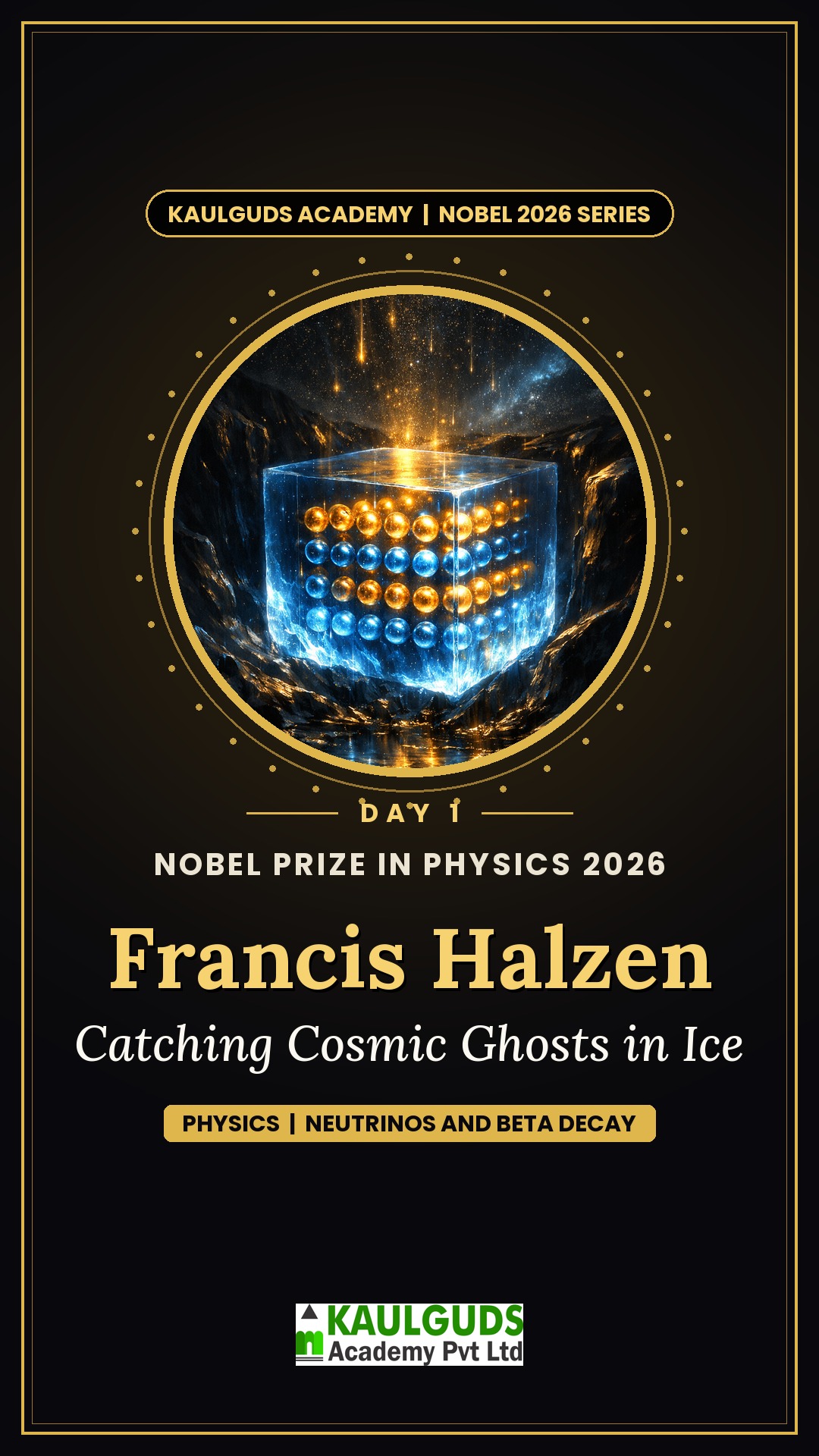
Francis Halzen grew up in Belgium and later studied physics at Louvain. He became fascinated by neutrinos, mysterious particles that travel through almost everything without a trace. Neutrinos are so hard to catch because they rarely interact with matter. At first, the idea of detecting them might seem impossible. Halzen had an unexpected approach: he used the clear, ancient ice found in Antarctica as a huge detector. When a neutrino from space happened to hit an atom in the ice, it would trigger a faint blue flash. By finding where the flash came from, the detector could even reveal the direction of the incoming neutrino. But why does the flash happen at all?
The science
Neutrinos are created during processes like beta decay in nuclear reactions. They pass through most material because they hardly interact with anything. However, in rare cases, a high-energy neutrino can collide with an atom, causing a tiny particle called a muon to speed through the ice. This moving particle emits a blue glow known as Cherenkov radiation, which is the textbook term for the effect. Scientists use special detectors to spot this blue light, pinpointing the path and direction of the original neutrino. By studying these rare events, physicists like Francis Halzen can learn about violent cosmic phenomena far beyond our solar system.
Try it
Questions students ask
Why was Antarctic ice used as a neutrino detector?
Antarctic ice is extremely clear and vast, making it perfect for spotting the tiny flashes of blue light produced when a neutrino interacts with atoms. This allows scientists to observe rare neutrino events from deep space.
What is Cherenkov radiation and how is it linked to neutrinos?
Cherenkov radiation is a blue glow produced when a particle moves faster than light travels through a medium like ice. When a neutrino hits an atom in the ice, it creates a fast particle that emits this blue light, helping scientists detect the neutrino.
More science stories
View all stories
The Sweating Scooter Seat
Why is your scooter seat wet at sunrise, even when it has not rained?

The Monsoon Rust Mystery
Why does Riya’s scooter handle turn reddish after one rainy night?

The Dal Colour Secret
Why did Riya’s dal turn red only when a soapy spoon touched it, not with lemon juice?