
The Mirror Molecule Trick
How did a clear liquid in Soai's lab twist light and pick just one mirror-image molecule?
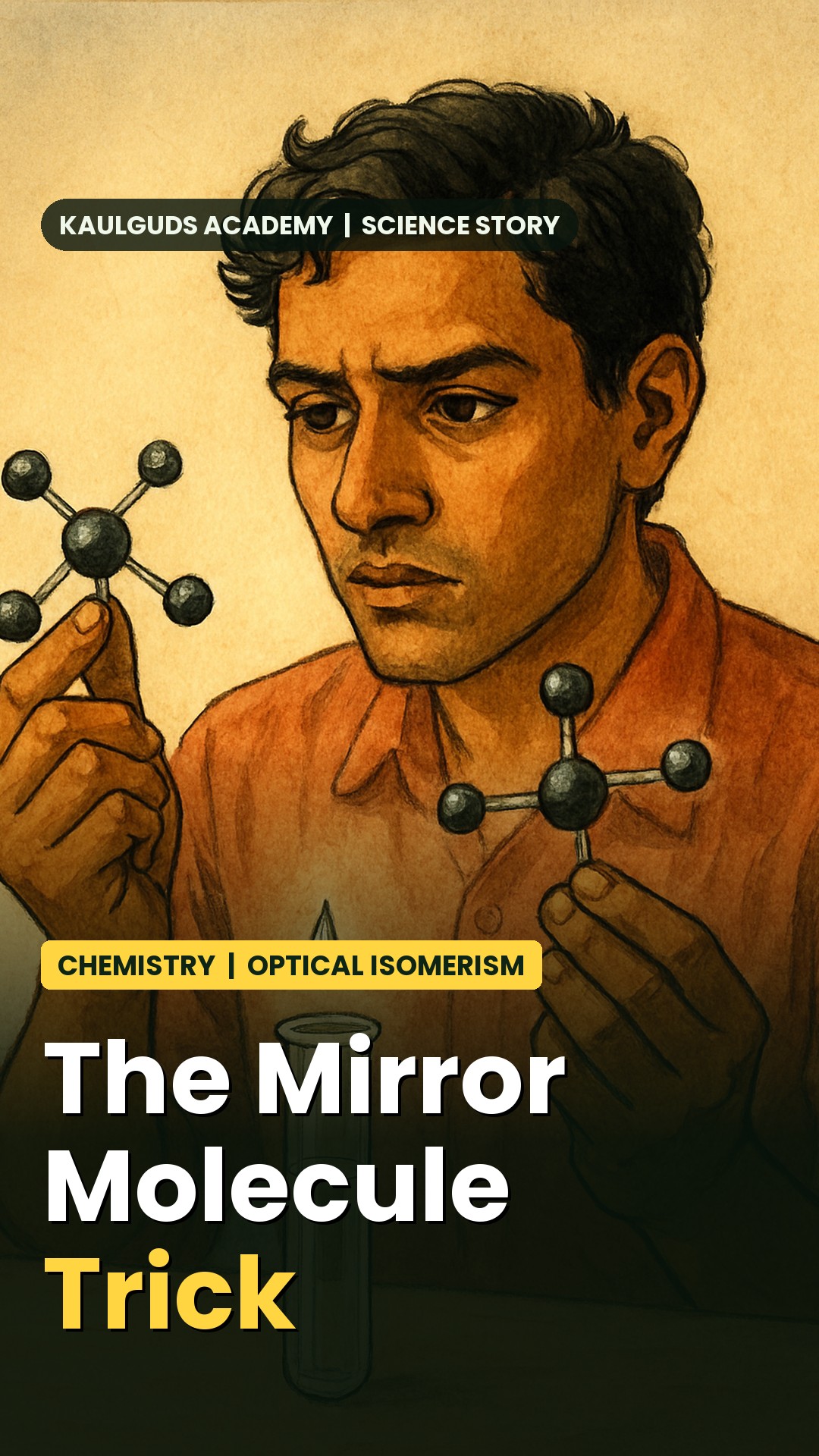
The story
One day in Kenso Soai's Tokyo lab, a single drop of liquid changed everything. Soai was trying to make molecules that are mirror images of each other, expecting both types to appear, like left and right hands. Surprisingly, after adding just a tiny mix, the next batch of molecules twisted light almost completely in one direction, even though the liquid looked clear. The usual balance between the two mirror-image forms disappeared, which didn't seem possible. Some thought maybe the glassware was dirty, but repeated experiments kept giving the same result. A single drop shouldn't decide the outcome. So what caused Soai's reaction to pick only one side?
The science
The answer lies in a process called asymmetric autocatalysis. In optical isomerism, molecules with the same composition can exist as mirror images, called enantiomers. These enantiomers twist polarised light in opposite directions. In Soai's experiment, when even a tiny bias toward one enantiomer was present, it increased its own production, leading to a chain reaction. This meant a very small difference at the start could determine the outcome for the entire batch. The process is precise and can be repeated, showing how a small imbalance can lead to a major change in such chemical reactions.
Try it
Questions students ask
What is an enantiomer in chemistry?
An enantiomer is one of a pair of molecules that are mirror images of each other but cannot be superimposed. They twist polarised light in opposite directions.
How does asymmetric autocatalysis work?
Asymmetric autocatalysis is a chain reaction where a small excess of one enantiomer causes more molecules of the same type to form, amplifying the original difference.
More science stories
View all stories
The Sweating Scooter Seat
Why is your scooter seat wet at sunrise, even when it has not rained?
The Monsoon Rust Mystery
Why does Riya’s scooter handle turn reddish after one rainy night?
The Dal Colour Secret
Why did Riya’s dal turn red only when a soapy spoon touched it, not with lemon juice?